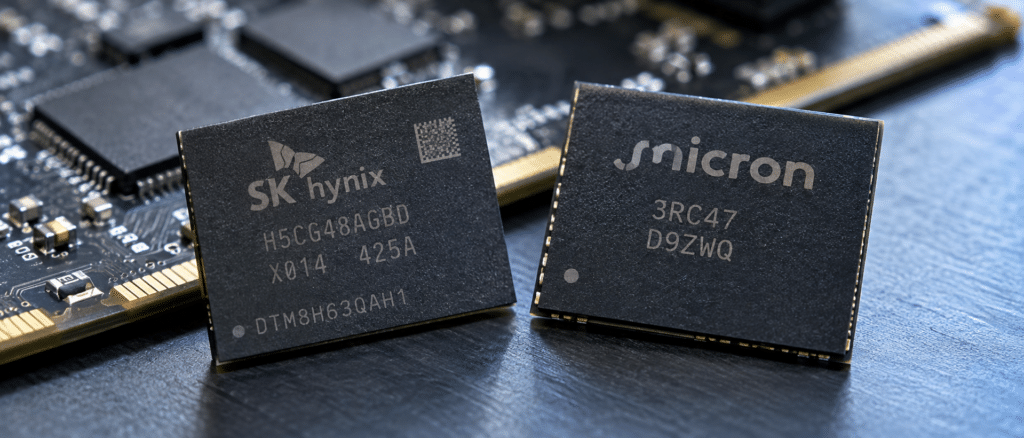
Micron Technology MU and SK Hynix shares traded lower on Monday as investors assessed the competitive implications of progress by China’s ChangXin Memory Technologies (CXMT) in developing a new memory-chip design that can store more data.
Broader weakness in technology shares added to the selling pressure as oil prices climbed to their highest levels in about two weeks.
Brent crude futures traded above $106 a barrel after deadly strikes on Riyadh’s international airport over the weekend.
Micron shares fell nearly 5%, while SK Hynix dropped 4%. SanDisk shares also declined 7%, extending pressure across memory and storage stocks.
CXMT has announced “key progress” in developing a new memory-cell architecture designed to increase storage density, a technology also being pursued by rivals Samsung Electronics and SK Hynix.
CXMT President Cao Kanyu said at an industrial event in Shanghai over the weekend that the company planned to introduce a new server-memory product based on the technology by the end of 2026, according to a company statement.
The development comes as investors closely monitor China’s efforts to build a more competitive domestic semiconductor industry and reduce reliance on foreign suppliers.
CXMT’s advances could eventually challenge established memory-chip manufacturers, although the extent of that threat will depend on production capacity, product performance and customer adoption.
What is the 4F square memory-cell design?
At the centre of CXMT’s latest development is the “4F square” design, which reduces the area occupied by each memory cell to four square F, with F representing the minimum line width of a semiconductor.
The structure allows manufacturers to fit more memory cells onto a single chip, potentially increasing storage density and improving manufacturing efficiency.
Mainstream commercial dynamic random-access memory (DRAM) currently uses a 6F square-cell structure.
Moving to a 4F square architecture could therefore offer manufacturers a way to increase the amount of data stored within a given area.
CXMT said the core of its design was its proprietary Vertical Surrounding Gate (VSG) transistor.
The technology uses a vertical gate architecture to address current leakage while significantly reducing the area occupied by individual cells and increasing storage density.
The Chinese company also expects to release a new generation of DDR5 registered dual in-line memory modules (RDIMMs) for enterprise servers by the end of the year.
It has not disclosed detailed specifications or an exact launch date.
The technology is also on the roadmaps of established manufacturers.
SK Hynix unveiled its 4F square development plan in 2025, while South Korean media outlet The Elec reported in April that Samsung planned to begin mass-producing sub-10-nanometre DRAM based on the design by 2028.
CXMT gains ground in global DRAM market
Investors have been concerned about CXMT’s growing presence in the memory-chip market for some time.
The company’s shares surged 466% on their trading debut in July, giving it a market capitalisation of just under $500 billion.
Its market-share gains have added to the focus on its potential to compete with the industry’s largest manufacturers.
A Counterpoint Research report published last month showed that CXMT captured 10% of the global DRAM market in the second quarter of 2026, compared with 4% in the same period a year earlier and 8% in the first quarter.
The pace of growth was faster than many analysts had anticipated.
The data also showed changes in the market shares of the three established DRAM producers.
SK Hynix recorded the sharpest decline, with its share falling to 25% in the second quarter from 39% a year earlier.
Samsung retained the largest share, at 38%, up from 33% in the second quarter of 2025.
Micron’s share increased more modestly, reaching 24% from 22% over the same period.
CXMT is also seeking to expand beyond conventional memory products.
The Information reported last month that the company had begun producing advanced high-bandwidth memory (HBM) in small quantities.
CXMT plans to expand that production in 2027, with Alibaba’s T-Head semiconductor unit and Chinese AI chip designer Cambricon already testing its HBM products with their processors.
Analysts see limits to the immediate competitive threat
Despite CXMT’s progress, analysts have argued that the company still faces constraints that could limit its near-term impact on established suppliers.
KC Rajkumar of Lynx Equity Research said supply limitations and customer qualification requirements make the threat less immediate than recent headlines suggest.
“CXMT supply is unlikely to dent the shortage Apple is facing in DRAM, nor could CXMT supply improve Apple’s negotiation position at traditional suppliers such as Micron,” Rajkumar wrote in August.
Ellie Wang, an analyst at TrendForce, told CNBC earlier last month that CXMT continued to strengthen its domestic position but remained relatively limited in high-capacity server memory and advanced products designed for AI servers.
Counterpoint Research Vice President Neil Shah, however, highlighted the company’s capacity expansion plans as an important factor to watch.
“An important thing to watch out for in H2 2026 would be how CXMT leverages its recent IPO to boost its prospects in terms of capacity expansion for HBM and LPDDR6,” Shah said.
“If CXMT can expand its capacity and capability to meet domestic and overseas demand, starting with PCs and potential Tier-1 international customers, the supplier’s market share will balloon and look a lot different a year from now. The question is not about ‘how’ but ‘when’ CXMT will be able to break into the Big Three Memory Club.”
Micron retains analyst support despite stock weakness
Meanwhile, analysts remain optimistic about Micron’s longer-term prospects, particularly as demand for memory chips continues to rise alongside investment in artificial intelligence infrastructure.
DA Davidson analyst Gil Luria raised his price target on Micron to $3,000 from $2,100 last week.
The new target implies roughly 200% upside from the stock’s current trading level and reflects expectations that the company could benefit from sustained demand for memory products.
Investors are still “early in their journey” when it comes to understanding Micron Technology and valuing its stock, Luria said.
The analyst argued that the market had yet to fully account for Micron’s expected growth over the next three to five years.
He also believes the company’s valuation remains unusually low relative to the earnings growth it is expected to deliver.
The post Why are Micron, SK Hynix stocks falling on Monday? appeared first on Invezz