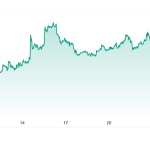

A $20 billion AI hedge fund gained 439% through June, lost roughly two-thirds of its value in July, and sold most of a $16 billion public-stock portfolio as leverage turned against it. The collapse offers a warning for Bitcoin: when Wall Street needs cash quickly, the first asset sold may not be the one that caused the loss, but the one still trading.
Leopold Aschenbrenner built one of Wall Street’s most persuasive investment pitches. The former OpenAI researcher argued that artificial intelligence was advancing fast enough to reshape energy, national security, computing, and nearly every large industry, then built a hedge fund around the companies supplying that future.
Situational Awareness invested in chips, power, storage, data centers, and other infrastructure expected to support the AI boom. The thesis initially worked almost too well: the fund gained 439% from the start of 2026 through June and grew to manage roughly $20 billion.
Then in July, it lost about 67% of its value.
The fund eventually sold most of a public-equity portfolio once estimated at $16 billion to Ken Griffin’s Citadel. Reported holdings included Broadcom, Intel, and CoreWeave, all closely linked to the enormous buildout behind AI.
Reuters reported that it wasn’t clear whether Situational received a formal margin call before the deal, but its portfolio included positions financed with borrowed money, and the fund faced pressure to raise capital or reduce exposure. The Financial Times separately reported that prime brokers were demanding more collateral from hedge funds concentrated in falling AI stocks.
Situational’s belief in AI didn’t have to be disproved for its trade to break: its lenders only had to become uncomfortable before the expected returns arrived.
That raises an uncomfortable question for Bitcoin: what do investors sell when an AI loss creates a cash demand, but the assets they would prefer to unload are difficult to move or unavailable until Wall Street reopens?
A margin call turns conviction into a deadline for AI funds
Hedge funds can borrow money to buy more assets than they could afford with cash alone. Borrowing magnifies gains during a rally, but it can also allow an otherwise manageable decline to tear through a fund’s capital rapidly.
Imagine a fund starting with $100 of investor money. It borrows $300 from a bank and buys $400 of AI stocks. A 10% decline creates a $40 loss. The portfolio is still worth $360, but the bank is still owed $300, leaving the fund with $60 of its original capital.
The stocks lost only 10%, but the fund’s equity fell 40%.
The lender doesn’t have to watch the remaining $60 disappear. It can demand more cash, ask for safer collateral, or require the fund to sell positions and repay part of the loan. That demand is called a margin call.
Large banks such as Goldman Sachs, JPMorgan, Bank of America, and Citigroup provide this financing through their prime-brokerage businesses. They also hold assets, process trades, and monitor whether each fund still has enough collateral to protect the loan.
Their risk departments aren’t judging whether an AI forecast will prove correct in 2030. They’re focused on whether the fund can repay its borrowing next week, not on the long-term outlook of the industry or the assets in which their clients are invested.
That’s why leverage essentially puts every investment on two different clocks. One measures how long the idea needs to work; the other measures how long its financing can survive while prices move in the wrong direction.
The AI unwind in five numbers
| Signal | Latest figure | What it shows |
|---|---|---|
| Situational Awareness’s return through June | +439% | Borrowing amplified a winning AI portfolio |
| Situational Awareness’s decline in July | About -67% | The reversal rapidly reduced its capital |
| Public-stock portfolio transferred | Most of $16 billion | Exposure had to be reduced at unusual speed |
| Asia-focused long-short fund return through July 28 | -18.6% average | The losses extended beyond one manager |
| US margin debt in June | About $1.5 trillion | Investors entered the decline with record borrowing |
The first two percentages create a result that looks less severe than the financing strain underneath it. An illustrative $100 investment that gains 439% reaches $539; a subsequent 67% decline leaves about $178.
The investment remains above its starting value, but the fund’s collateral position can still be badly damaged. New clients may have invested after the early gains, the portfolio may contain different levels of leverage, and lenders judge their protection using current values rather than the manager’s lifetime return.
Situational also wasn’t alone in this trade. Asia-focused fundamental long-short funds lost an average of 18.6% through July 28, their largest monthly decline in Goldman Sachs data.
US investors had borrowed a record $1.5 trillion through margin accounts by June. Their net balance with brokers fell into a roughly $1 trillion deficit for the first time, leaving more portfolios vulnerable to forced selling when prices declined.
The Bank for International Settlements had warned in June that a reversal in AI optimism could produce wider financial consequences. AI-linked companies were becoming more prominent in credit markets, suppliers were borrowing to fund expansion, and the infrastructure buildout increasingly depended on debt.
The current pressure therefore reaches beyond a debate over whether an AI stock looks expensive. Loans, derivatives, corporate bonds, private credit, and collateral agreements have grown around the boom, giving a fall in share prices several routes into the wider market.
Forced sellers unload anything that might look like cash
A margin call changes the question that a portfolio manager has to face.
Before the call, the manager asks which asset offers the strongest future return. But after the margin call, the manager asks which asset can turn into dollars the fastest before the lender’s deadline hits.
Private AI holdings can be enormously valuable, but selling them often requires financial reviews, legal documents, negotiations, and an agreed valuation. Corporate bonds can become harder to trade during market stress, while unloading a large block of public stock can push its price lower and create additional losses.
Situational reduced that risk by transferring much of its public portfolio directly to Citadel. A fund without a buyer willing to absorb billions of dollars in one transaction may have to raise cash across several unrelated positions.
Bitcoin is part of this because it can solve that cash problem faster than many other assets. It trades across nights, weekends, and holidays, has a visible global price, and normally offers far more liquidity than private shares or specialized credit positions.
Those features don’t make it the weakest investment in a portfolio, but they make it the easiest one to sell.
Coinbase Institutional has previously argued that Bitcoin can be among the first assets cross-market funds unload during a liquidity squeeze because it combines 24-hour trading, high volatility, and deep markets.
A fund can remain bullish on Bitcoin while selling it. But a belief about future scarcity doesn’t provide the dollars a prime broker wants today.
Bitcoin is open before Wall Street is
Consider an AI-heavy fund ending the week with falling chip stocks and collateral near its minimum requirement. Its lender reviews the exposure, raises the required cushion, and demands cash.
The fund’s US stocks are outside regular trading hours. Private AI shares can’t be sold before Monday, while a large bond transaction may require several calls to dealers.
But spot Bitcoin trades around the clock.
The fund sells BTC during the Asian session even though nothing has changed in the Bitcoin network. The decline reaches leveraged crypto traders, exchanges begin closing undercollateralized positions, and those automated sales push the price lower.
That’s how a cash demand created by AI stocks turns into a crypto liquidation event.
CryptoSlate has documented similar transmission through other markets. During a previous yen carry-trade scare, a change in currency financing threatened to force multi-asset investors to cut risk, exposing Bitcoin to losses even though there was no new crypto-specific catalyst.
Another macro decline produced $2.56 billion in Bitcoin liquidations, showing how crypto leverage can transform an external shock into a much larger forced-selling wave.
The process is like selling a car after a kitchen fire. The car didn’t cause the damage, but it’s the fastest and easiest way of raising enough cash to pay the bill.
There’s no evidence that Situational Awareness owned Bitcoin or sold it during the Citadel transaction. Its reported portfolio centered on public equities and private investments, including a stake in Anthropic.
The Citadel deal may also have reduced wider market pressure. Moving a large portfolio to a single buyer prevented billions of dollars of AI shares from being dumped through ordinary trading, where falling prices could have triggered further collateral calls.
The AI retreat also doesn’t prove that demand for computing power has disappeared. Goldman Sachs described the record technology-stock selling as a reset of crowded positions rather than a collapse in AI conviction, while strong cloud earnings later helped several technology shares recover.
Bitcoin becomes vulnerable when four conditions overlap: AI stocks keep falling, lenders demand more collateral, the affected funds own crypto, and those funds need cash faster than their other assets can provide it.
The first sign would be BTC declining alongside AI shares without a new exchange failure, regulatory action, or network problem. Selling that begins during Asian hours or over a weekend would strengthen the connection, particularly if crypto liquidations accelerate after the initial move.
CryptoSlate has already examined how Bitcoin and AI equities compete for the same marginal dollar. ETF flows could later show that traditional investors also reduced exposure, but US-listed funds follow equity-market hours and can’t explain every overnight move.
The earliest evidence would probably appear in spot Bitcoin, perpetual futures, and other continuously traded markets.
Leverage can break an AI portfolio without the AI thesis failing; losses only need to arrive before the investor can provide more collateral.
The next large Bitcoin decline may begin without a hacked protocol, government ban, or failed crypto company. It may begin when an AI investor receives a call from a bank and sells the largest liquid asset still available.
The post The sudden collapse of a $20 billion AI fund reveals why Bitcoin is the first thing Wall Street sells when margin calls hit appeared first on CryptoSlate.