
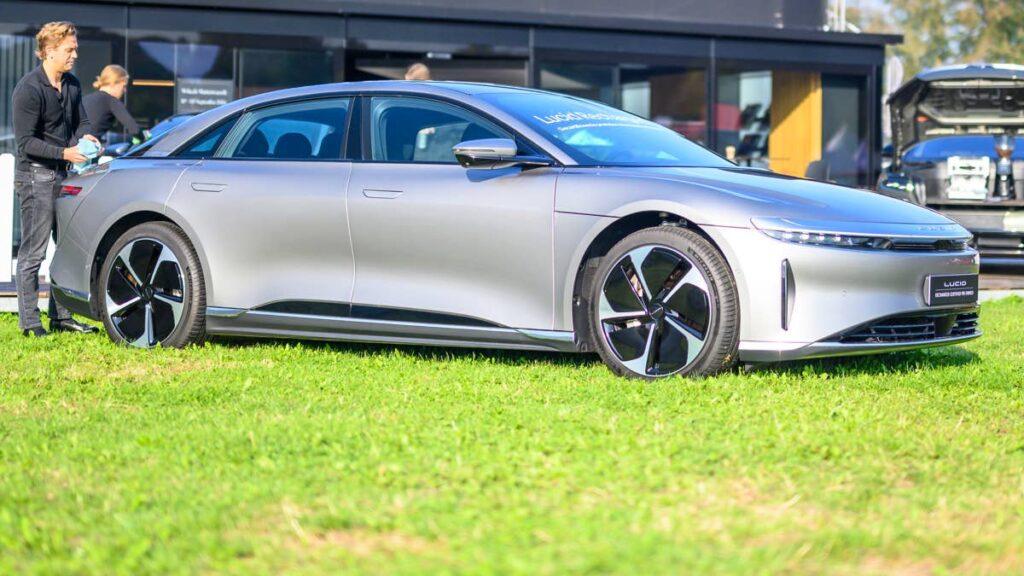
Lucid Group spent the first five months of 2026 building cars faster than it could sell them.
By June, a new CEO had stepped in, eliminated a second shift at the Arizona factory, and told investors the company would stop building vehicles it couldn’t deliver.
Lucid (LCID) is an electric vehicle manufacturer and competes primarily with Tesla in the U.S.
Valued at a market cap of $1.53 billion, LCID stock is down 99% from its all-time high in October 2026.
Lucid delivered fewer cars than Wall Street expected
Lucid said it built 2,954 vehicles and delivered 3,806 in the third quarter, according to its production and deliveries release.
The company says it planned to deliver more than it built and wants to turn inventory into cash.
Reuters, citing Visible Alpha, put the average analyst estimate at 4,687 deliveries, which means the actual number came in 18.8% below estimates.
Also Read: Down 99%, popular EV stock is ripe bankruptcy candidate
Deliveries also fell 6.7% from a year ago and below Q2 deliveries of 3,953 vehicles.
According to Autoblog, Lucid has pulled its 2026 production guidance of 25,000 to 27,000 vehicles. Moreover, consensus delivery estimates for the year have dropped to about 17,070.
So, Lucid would need to deliver 6,200 vehicles in Q4 to meet these estimates, which is unlikely, given recent trends.
Here is how the year looked, using the company’s reported figures:
- First quarter: 5,500 built, 3,093 delivered
- Second quarter: 4,774 built, 3,953 delivered
- Third quarter: 2,954 built, 3,806 delivered
- First nine months: 13,228 built, 10,852 delivered
So, the company has built 2,376 cars that are yet to be delivered. Unsold cars also tie up cash flow, and in Q2, Lucid reported a free cash outflow of $1.47 billion.
CFO Taoufiq Boussaid said much of the outflow was tied to a build-up in inventory, including finished Gravity SUVs made ahead of deliveries.
He described it as working capital trapped on the balance sheet rather than permanent burn.
He also made a telling admission on the August 4 earnings call. In the first five months of the year, he said, Gravity production outpaced demand.
Sjoerd van der Wal / Getty Images
New Lucid CEO Napoli hits brakes
Silvio Napoli is the new CEO of Lucid Motors. In the first month, he cut the U.S. workforce by 18% and eliminated a second shift at the Arizona factory. Together, the moves are projected to save $158 million a year.
Napoli explained:
“We deliberately reduced production by eliminating a second shift because building vehicles faster than we could deliver them was consuming cash and increasing inventory.”
He drew a hard line on pricing, too, stating, “We will not buy volume at the expense of cash or vehicle economics.”
More Wall Street:
- Nvidia and Micron are about to lord their successes all over Wall Street
- Nvidia, Palantir, and Alphabet send waves through Wall Street
- Wall Street elites will pocket windfall from record $46 billion profits
A key remark was about the company’s track record.
“Potential is not performance, and effort is not the same as results,” Napoli said.
Morgan Stanley analyst Andrew Percoco sounded skeptical on the same call.
He noted the Arizona plant was running at low utilization while demand is “relatively de minimis in the near term.”
Napoli said how to fill that capacity is part of Lucid’s strategic planning.
The second quarter financials explain the urgency:
- Revenue was about $405 million, up 56% from a year ago.
- Gross margin was negative 105%.
- Lucid took a $300 million inventory impairment charge.
- It ended Q2 with $3 billion in total liquidity
Lucid has enough cash to sustain its burn rate over the next 15 months. It is counting on about $1.4 billion in cash improvements this year, with inventory reduction as a key piece.
Management also said it drew an additional $800 million on a loan facility after the quarter ended.
It is not just a Lucid problem
Lucid and several other EV makers are wrestling with slowing demand amid a challenging macro backdrop.
The consumer price index, or CPI rose 3.4% year over year in September, driven by elevated oil prices.
Notably, the Conference Board’s latest survey showed the weakest consumer confidence since 2014.
Napoli acknowledged the pressure, saying the EV market is experiencing “near term demand uncertainty.”
Related: EV maker’s biggest ever recall hits 27,000-plus sedans
He added that Lucid remains confident in the long-term shift to electric vehicles.
Lucid still saw a 19% increase in Q2 deliveries compared to the year-ago period. Saudi Arabia has committed to buy more than 4,000 vehicles in 2026 under an existing agreement.
Lucid also says the Uber and Nuro robotaxi project includes 35,000 units, with ramp up expected as the project goes live.
The company says Gravity demand “continued to regain momentum” in the third quarter. Management also blames earlier stop sale actions for part of the weakness.
What next for Lucid stock
The next real test is Lucid’s third quarter earnings report on November 9. Napoli promised a progress update on the $1.4 billion cash plan and a new liquidity outlook. He also said formal 2027 guidance would come with year end results.
For now, the evidence points one way. Lucid built for demand that is yet to materialize.
Consensus estimates compiled by TIKR suggest cumulative free cash outflow could surpass $10 billion by 2030, meaning the EV maker will have to raise capital several times over the next four years.
Investors should expect Lucid stock to underperform the broader market until it improves profit margins and reduces inventory levels.
More Stocks News
- Hewlett Packard, Dell have a PC problem
- Oracle’s ‘force majeure’ warning lands as AI power gets scarce
- OpenAI CEO Sam Altman has a biblical-level warning about AI
- Warren Buffett warns of a reality check coming for stock investors