
AAVE, the native token of the Aave DeFi platform, is now available on the Solana blockchain network.
The move will give Solana users access to one of the largest lending protocols in decentralized finance without leaving the network.
This came less than two days after the Solana Foundation revealed that it would deploy part of its treasury into Aave.
Through this action, the non-profit joined a broader industry effort to contain the fallout from the KelpDAO rsETH $292 million exploit and restore confidence in decentralized lending markets.
Solana Foundation aids Aave recovery
On April 25, Lily Liu, chair of the foundation, said the nonprofit is lending USDT to Aave to support recovery efforts after the exploit left major DeFi protocols exposed to unbacked collateral and liquidity stress.
The step marks an unusual cross-chain intervention by Solana, which has spent years building its own DeFi economy around native lending, trading, and liquid staking applications.
It also gives the foundation a direct role in a recovery effort centered on Aave, a protocol more closely associated with Ethereum and its layer-2 networks.
Liu framed the move as support for the broader open-finance market, saying blockchain economies do not operate in isolation and that Solana’s long-term health depends on a functioning DeFi sector beyond its own ecosystem.
For Solana, the intervention signals that competition among chains does not preclude coordination when a failure threatens the market structure on which they all depend.
A bridge failure becomes a DeFi problem
The April 18 $292 million exploit began with KelpDAO’s rsETH, a liquid restaking token, after attackers allegedly exploited a weakness tied to its LayerZero bridge configuration.
According to reports, the attackers were able to redeem 116,500 unbacked rsETH tokens on Ethereum before depositing the assets as collateral across Aave, Compound, and Euler, then borrowing roughly $292 million in ETH and other assets.
This action caused broader contagion, especially in Aave’s lending markets, where platform users exited en masse, and resulted in WETH utilization reaching 100% within hours of the exploit.
Galaxy Research explained:
“At full utilization, Aave’s design doesn’t allow withdrawals, because there is no idle liquidity in the pool to redeem against. Whoever withdraws first is made whole, while whoever comes later must wait for new supply to arrive or borrowers to repay.”
Oak Research, a crypto intelligence firm, said the mass exit led to a 17% decline in total value locked in DeFi, with Aave experiencing more than $12 billion in outflows.
The firm argued the episode could have become a defining failure for DeFi because it combined a bridge misconfiguration, a systemically important lending venue, and lenders unable to withdraw funds from depleted pools.
The liquidity crunch also showed how lending protocols can operate as designed while still importing risk from outside infrastructure.
Aave pools depend on borrowers, collateral, and liquidations functioning normally. When collateral quality collapses suddenly, lenders can be left waiting for liquidity until borrowers repay, liquidations occur, or new deposits enter the market.
Can ‘DeFi United’ restore investors’ confidence?
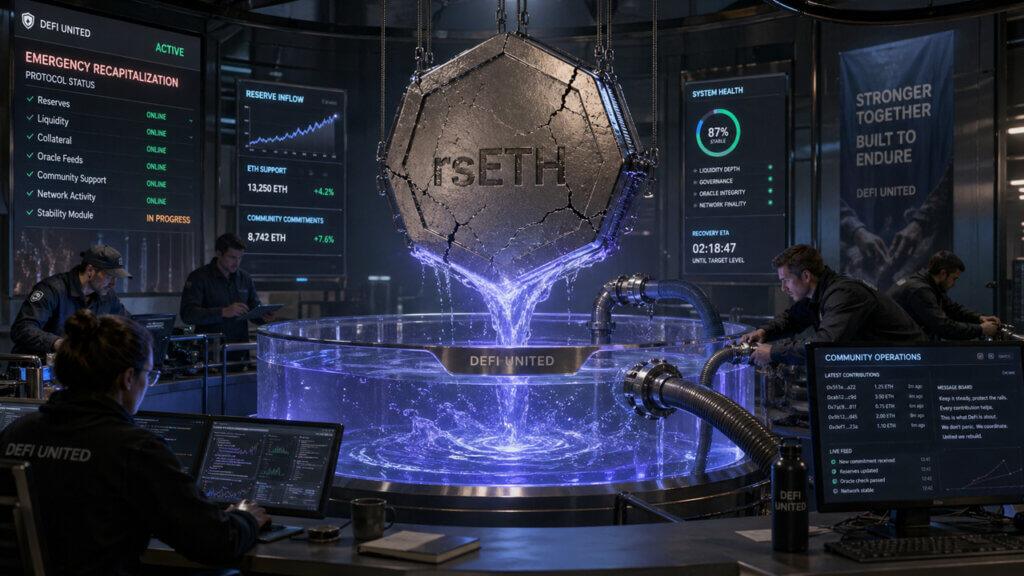
In response to the incident, Aave and KelpDAO helped organize DeFi United, a recovery vehicle aimed at replenishing rsETH reserves and making affected users whole.
According to DeFi United’s official website, the effort has drawn commitments of nearly $240 million from several major DeFi participants, including Aave DAO, Arbitrum DAO, Mantle, Ether.fi, Lido, Kelp, Golem Foundation, and individual contributors.
Oak Research said this recovery effort is working because Aave was the protocol at risk.
In its view, the response may have been different if the losses had been isolated to a smaller restaking protocol or a bridge without broader systemic importance. Aave, as the largest DeFi lending venue, had stronger incentives to preserve its reputation and avoid a precedent in which lenders take losses from collateral accepted by the protocol.
That is what makes Solana’s support notable. The foundation is stepping into a sector-wide effort to prevent a bridge-linked collateral failure from damaging confidence in DeFi’s largest lending venue.
The move also gives Solana a strategic opening. Bringing AAVE to Solana could deepen cross-chain liquidity, broaden access for Solana users, and give Aave another distribution channel at a time when lending protocols are reassessing collateral risk, bridge dependencies, and emergency backstops.
Meanwhile, the recovery may still leave governance questions unresolved. Aave tokenholders must weigh the cost of using treasury assets against the reputational risk of allowing users to absorb losses.
While DeFi United can help close the immediate shortfall, the KelpDAO exploit has already shown that collateral standards, bridge design, and protocol risk controls are no longer separate issues.
The post Latest $290M exploit hit DeFi so hard it forced Aave onto Solana as part of rescue efforts appeared first on CryptoSlate.