Ethena’s USDe, a synthetic dollar targeting $1, has 51.2% of its backing allocated to DeFi and institutional lending, according to risk assessor LlamaRisk’s October 12 assessment. The allocation figure does not measure actual borrower drawdowns or cash available for immediate withdrawal. For holders, usable reserve assets and access to an exit near the peg are separate tests.
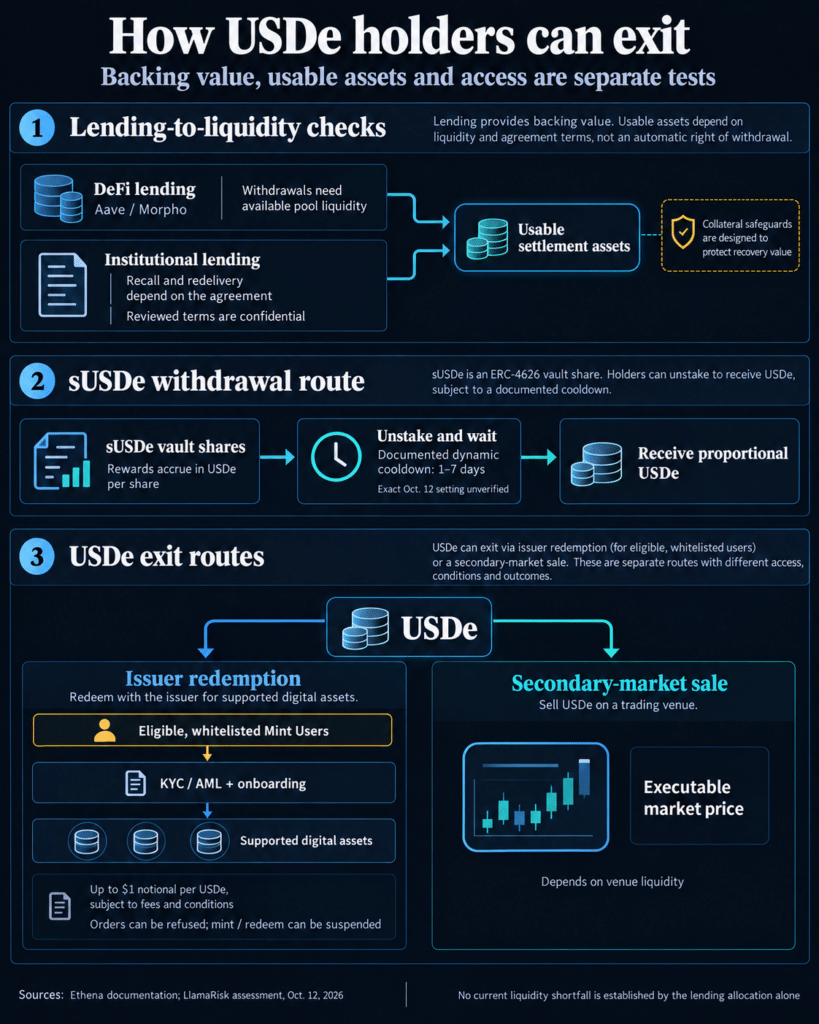
Eligible counterparties can redeem USDe directly with Ethena, subject to its conditions. Other holders rely on secondary markets for an exit. Withdrawing USDe from sUSDe, its staking vault share, requires a separate unstaking process. A lending position can have excess collateral while supplied stablecoins remain borrowed. Recovering those assets depends on available pool liquidity or the applicable loan agreement’s recall and redelivery provisions.
The global snapshot reports $4.76 billion of backing against 4.76 billion USDe outstanding. Its lending allocations are 36.9% DeFi and 14.3% institutional, alongside 24.9% liquid stablecoins, 17.6% crypto basis and 6.0% real-world assets.
LlamaRisk discloses partial Aave DAO funding and its independent Ethena proof-of-reserves attestation role. It says it received no protocol or affiliated-entity compensation for this assessment.
The diversification itself predates this snapshot. Ethena’s March governance discussions already described lending deployments, and CryptoSlate covered the broader backing shift in August.
When lending assets become redemption assets
Ethena’s DeFi lending policy describes reviewed markets with excess borrower collateral, conservative loan-to-value parameters and exposure limits subject to governance and Risk Committee review. Those safeguards aim to limit losses. Aave and Morpho’s withdrawal mechanics determine whether underlying assets are available to recover.
Under Aave’s withdrawal rules, a supplier can take out only the amount available in a pool that has not been borrowed. Morpho’s market design also makes sufficient liquidity a condition for withdrawal.
| Lending category | Share of backing, Oct. 12 | Route back to settlement assets |
|---|---|---|
| DeFi lending | 36.9% | Withdraw supplied assets, subject to available market liquidity. |
| Institutional lending | 14.3% | Recover lent assets under the applicable agreement’s recall and redelivery provisions. |
For institutional lending, Ethena describes stable-asset loans backed by collateral worth more than the amount borrowed, including liquid BTC and ETH. Qualified custody and triparty arrangements, in which an independent agent holds and administers collateral, are designed to protect the protocol’s claim. Counterparty eligibility and aggregate exposure limits are subject to committee oversight.
LlamaRisk’s April review framework examines collateral ratios, custody segregation, enforceable security interests, liquidation rights, recall notice and redelivery timeframes. On Ethena Governance, its March review of the Maple and Anchorage agreements found no material contractual deficiencies. The individual terms and commercial thresholds remain confidential.
The Anchorage agreement reviewed in March was with A1, Ltd., a Cayman Islands group entity distinct from the OCC-chartered Anchorage Digital Bank. Maple’s agreement was through Delaware-based Protocol Pool Operations Alpha LLC.
The collateral, custody and legal safeguards are intended to mitigate credit risk. Their public descriptions do not establish the exact timetable for recovering lent assets under the reviewed institutional agreements. For a holder’s exit, protection of recovery value and the timing of delivery therefore need to be assessed together.
USDe redemption and sUSDe withdrawals
Holding USDe does not automatically provide access to Ethena’s primary redemption facility. Its published terms reserve that service for eligible Mint Users who have completed know-your-customer and anti-money-laundering checks, other onboarding procedures and whitelisting. An ordinary holder needs to become an eligible Mint User to redeem directly, or use a secondary-market exit.
The terms describe conditional redemption into supported digital assets representing a pro-rata portion of reserves, capped at $1 in notional value per USDe and subject to fees and other conditions. Receiving a backing asset is a different step from receiving dollars in a bank account. Ethena’s order process uses signed prices and operational acceptance checks, so a nominal redemption framework does not make every requested order executable.
LlamaRisk’s October 12 assessment of the Ethereum contract lists PYUSD, USDC, USDG, USDT, USDm and USDtb as enabled stablecoins, plus DAI with smaller limits. It reports an aggregate redemption ceiling of 20 million USDe per block, against 200 million for minting, and 2 million in each direction for DAI. These are contract ceilings, not available cash. The issuer can suspend minting and redemption without the controller’s 24-hour wait.
This access is central to Ethena’s peg-arbitrage mechanism. An authorized participant can buy USDe at a discount on an external market and redeem it for backing assets. The incentive to close that gap depends on being able to obtain a usable quote and receive the assets. Secondary-market sellers rely on that arbitrage channel, as well as the liquidity of the venue where they sell.
sUSDe adds another stage. It is an ERC-4626 vault share, representing a proportional claim on USDe in the staking contract. Rewards increase the USDe represented by each share. Its relevant exchange rate is USDe per share, rather than a fixed $1 target for sUSDe itself.
Ethena’s current staking guidance describes a governance-set dynamic cooldown between one and seven days. Its technical documentation places pending unstaked USDe in USDeSilo before withdrawal. The guide gives a range rather than establishing the active October 12 setting. Completing that process delivers USDe; selling or redeeming that USDe is a further step, with its own liquidity and eligibility conditions.
The reserve buffer and the checks that matter
Ethena’s reserve fund is intended to absorb negative protocol revenue and backing shortfalls. LlamaRisk’s September assessment put it at about $62.1 million. A loss buffer serves a different purpose from assets ready for immediate settlement.
Ethena’s reserve-fund policy says its ongoing allocation of protocol revenue is 0%, with revenue directed instead to incentives and promotional distributions. That allocation applies to new revenue; the fund’s existing balance is a separate measurement.
September’s position mapping identified Aave, Morpho, Jupiter Lend and Kamino exposures, alongside Maple, FalconX, Kraken, CBAM and Anchorage institutional positions. Those detailed venue weights remain historical.
Blockworks Advisory’s March cooldown analysis makes the liquidity-accounting distinction explicit. It separates withdrawable lending positions from those constrained by utilization, and explains that cycling USDtb already held as USDe backing through USDe minting and redemption creates no net liquidity.
Ethena’s institutional-lending policy describes committee-reviewed limits without specifying a numerical cap or floor.
For holders, the observable lending test is available unborrowed liquidity alongside the amount supplied to each market. Institutional recall and redelivery disclosures need to sit alongside collateral quality. A collateralized position and a position that can deliver settlement assets on demand answer different questions.
Redemption eligibility, accepted orders and the active sUSDe cooldown complete the exit test.
The post More than half of Ethena’s USDe backing is allocated to lending appeared first on CryptoSlate.