
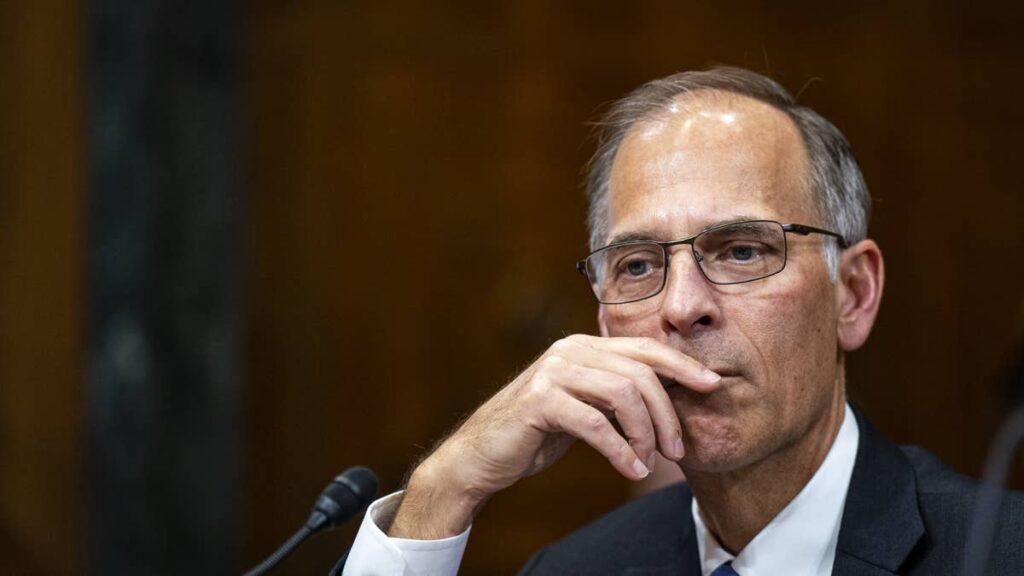
Mark Zandi is giving Americans a reason to look beyond the bleak headlines surrounding the country’s $40 trillion debt burden. The Moody’s Analytics chief economist just pointed to an AI productivity boom that could help ease Washington’s financial squeeze.
That possibility is massive, as more economic output could potentially mean more tax revenue, making a daunting budget problem more manageable.
Speaking on the Inside Economics podcast, in remarks highlighted in Moneywise’s Sept. 29 coverage, Zandi expressed optimism that technology could deliver substantially stronger productivity gains.
There is precedent for technology helping accelerate growth. Whether this boom can repeat that performance is another matter.
Nevertheless, even a stronger economy might leave Washington facing uncomfortable choices about taxes and major spending programs.
Zandi’s AI hope hinges on making America’s debt easier to carry
Mark Zandi’s argument is based on a simple idea: America’s debt becomes easier to manage when the economy supporting it grows faster.
“There is a lot of optimism around that we could see potentially much stronger productivity gains,” he said on Moody’s Inside Economics podcast, according to the Moneywise article.
Productivity means producing more per hour worked. If AI helps businesses accomplish that, profits and taxable income could rise, giving Washington more revenue without necessarily increasing tax rates.
Zandi pointed to Goldman Sachs’ scenario in which productivity growth approaches 3%, versus roughly 2% after the pandemic.
“That would be consistent with what Goldman thinks is going to happen here in terms of AI,” he said.
Read more economy news from TheStreet.
Recent data provide context, though they do not establish an AI breakthrough. The Bureau of Labor Statistics reported on Sept. 3 that nonfarm business productivity rose 2.2% from a year earlier in the second quarter. Since late 2019, annualized growth has averaged 2.1%.
The fiscal opportunity could be substantial. A July Brookings paper estimated that a major productivity boom could reduce annual deficits from roughly 6% to 2% of economic output.
But smaller deficits still mean borrowing. The paper also warned that job displacement, higher interest costs, and other effects could erase more than half the potential benefit.
That makes Zandi’s qualification essential: stronger productivity might, “if not bail us out of our fiscal problems, certainly make them a lot easier.”
AI could buy breathing room. Washington would still need to confront tax and spending choices.
Bloomberg / Getty Images
Musk’s abundance promise faces a productivity reality check
Zandi’s cautious optimism shares a foundation with Elon Musk’s sweeping promise.
According to the Tesla (TSLA) and SpaceX (SPCX) CEO, AI could expand economic output enough to change what governments and households can afford.
At President Donald Trump’s Sept. 29 White House gathering on Super Intelligence, Musk said, “The most likely outcome is an age of abundance,” adding, “We have universal high income,” as reported by USAToday.
But a richer future remains a forecast. Evidence that AI has already delivered a broad productivity breakthrough is considerably less convincing.
A study summarized by the National Bureau of Economic Research surveyed nearly 6,000 executives across the United States, Britain, Germany, and Australia. Some 89% reported no impact from AI on labor productivity over the preceding three years as reported by Fortune.
More Economy:
- Kevin O’Leary raises stark concern about inflation
- Goldman Sachs delivers its verdict on inflation and jobs
- Bank of America issues stark warning on Fed and economy
That is self-reported evidence, rather than proof that AI produces no benefits. Nevertheless, it challenges the assumption that widespread adoption automatically translates into greater output.
A narrower experiment from research nonprofit METR found experienced developers took 19% longer to complete tasks using early-2025 AI tools. The finding applied to particular developers and established projects, not the entire economy.
Crucially, METR said in February 2026 that newer tools likely improved performance, while selection problems prevented a reliable updated estimate.
Together, these findings expose the gap between impressive technology and measurable economic returns. Companies must turn individual tasks into more valuable output more quickly while absorbing implementation and verification costs.
For Zandi’s debt argument, the test is sustained growth in taxable income. Musk’s abundance vision supplies the ambition; Washington cannot treat those hoped-for revenues as money already in the bank.
Invest in measurable gains, and keep protection against disappointment
Zandi’s optimism supports diversification, not an all-in bet that AI will rescue America’s finances.
Investors need to distinguish companies converting technology spending into cash from those selling distant promises.
For stocks, favor evidence of improving margins, revenue per employee, and free cash flow. A productivity boom can lift profits, but an expensive purchase price can still undermine returns.
Treasury investors face a different calculation. Reuters reported that the 10-year yield touched 5.34% on Oct. 1, its highest since 2002, before easing to 5.27%. Those yields offer income, but longer bonds remain vulnerable if inflation or borrowing pressures push rates higher. Consider staggering maturities instead of betting everything on falling yields.
Gold also needs realistic expectations. Reuters reported bullion near $4,183 an ounce after a 6% September decline, while silver traded around $61.11. Fiscal anxiety does not guarantee immediate gains when interest-bearing assets become more competitive.
Treat gold as portfolio insurance and size silver more cautiously, as industrial demand adds economic sensitivity.
Related: Palantir CEO Karp drops “Warfighter” hot take before super intelligence meeting at White House