
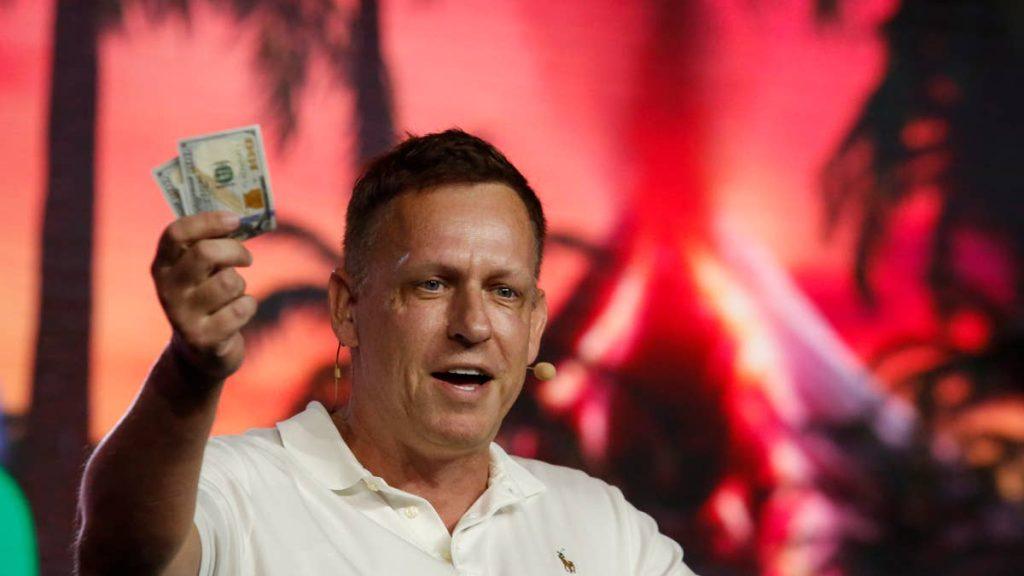
Peter Thiel’s Thiel Macro hedge fund has been conspicuously out of investing in stocks for a while.
His fund reported zero 13F holdings at the end of December 2025 and again showed nothing as of March 31, 2026.
That’s why Thiel Macro’s Q2 filing is particularly shocking, returning with a massive $418.7 million portfolio.
His biggest Q2 swing is the most interesting.
The Big Tech giant has been firmly in the green over the past month after reporting earnings, after investors got clearer evidence that the enormous capex is translating into durable sales. Nevertheless, its management bumped 2026 capital spending to $220 billion.
Instead of punishing that spending, though, Wall Street sent the stock sharply higher.
Now the Palantir co-founder has put $118 million behind that tech behemoth, making it the biggest position in his rebuilt public-equity portfolio.
Peter Thiel makes Amazon his biggest bet
That mystery Big Tech stock is Amazon (AMZN).
Thiel Macro scooped up nearly $118 million worth of Amazon stock during Q2, making it the fund’s largest holding at 28% of its $418.7 million 13F portfolio.
Every position in the portfolio was new, and the timing was notable.
According to Reuters, Amazon shares skyrocketed roughly 14% on July 31 post earnings, with investors responding to evidence that its massive AI spending is starting to generate visible returns. The stock later closed at $278.09 on August 10, up about 19% for the year at that point.
More Manager Buy/Sells:
- Michael Burry increases his bet against popular chip giant
- Warren Buffett reveals he broke his own investing pattern
- Mark Cuban bets on MLB with Athletics minority stake
The obvious reason was AWS.
Amazon Web Services sales surged 37% to $42.2 billion, its quickest growth in 18 quarters and comfortably above the nearly 31% growth Wall Street expected.
AWS’s operating income rose to $16.6 billion, accounting for 60% of Amazon’s total $27.5 billion in operating profit.
More importantly for the AI thesis, AWS backlog shot to the moon at $496 billion from $364 billion in the previous quarter, a roughly 36% jump, as per Reuters. Encouragingly, Amazon says much of its 2027 cloud capacity is already reserved, with some 2028 capacity also spoken for.
That also explains why investors ended up tolerating Amazon’s lofty 2026 CapEx raise to $220 billion, even as trailing free cash flow swung to a $7.6 billion outflow.
The spending is linked to contracted demand rather than to speculative capacity.
Though Thiel hasn’t publicly discussed his latest purchase, his admiration for Amazon’s business model dates back years.
In Thiel’s startup book Zero to One, he wrote simply: “Amazon shows how it can be done,” gushing over its strategy to dominate a specific market before expanding into adjacent ones.
That makes his new position a lot less random.
Thiel is buying into a company whose scale strategy he has long admired, just as AWS appears to be validating the AI expansion cycle.
Marco Bello/Getty Images
Peter Thiel’s investing strategy explained
Peter Thiel’s investing style is based on two key pillars: patience and concentration.
From his Q2 filing, we can infer that, instead of spreading capital broadly, the fund concentrated it around a couple of related ideas.
That fits Thiel’s broader investment philosophy.
Founders Fund has long championed contrarian investing, arguing that consensus opportunities typically offer limited upside because much of the optimism is already baked into valuations.
The goal is to identify something important enough that the market might still be underestimating.
On top of that, Thiel brings a ton of pedigree to make those calls.
He co-founded PayPal, served as CEO, and took it public. He later co-founded Palantir (PLTR) and is still the company’s chairman. Moreover, Thiel is known for making the first outside investment in Facebook and is a partner at Founders Fund, which has backed companies including SpaceX and Airbnb.
Naturally, these accomplishments have made him tremendously wealthy, with Forbes estimating Thiel’s real-time net worth at $32 billion as of August 15.
His latest portfolio reshuffling underscores a similar mindset.
Instead of just chasing AI software or chip stock names, Thiel Macro is targeting the bottleneck behind the boom.
Thiel’s bigger bet is on AI’s power problem
Thiel Macro’s other holdings underscore the broader AI thesis that it requires far more electricity.
Nearly 72% of the $418.7 million portfolio is allocated to energy and power-related stocks. Thiel scooped up 1.19 million shares of Vista Energy (VIST) worth $75.9 million, reopened 372,755 shares of Vistra (VST) worth $59.1 million, and added 308,617 American Electric Power (AEP) shares worth $42.2 million, as reported by 13F.info.
Moreover, he also invested in 264,450 DTE Energy (DTE) shares worth $40.3 million, 839,319 FirstEnergy (FE) shares worth $39.9 million, 517,124 CMS Energy (CMS) shares worth $39.6 million, and 200,000 X-Energy (XE) shares worth $3.7 million.
The AI connection is most evident at Vistra (VST).
According to Reuters, the energy giant has a 20-year agreement to supply AWS with 1,200 megawatts of nuclear power from Comanche Peak, as well as major nuclear agreements with Facebook parent Meta Platforms (META).
Moreover, AEP also offers another direct route into the relentless data-center boom.
The utility said in February it had agreements that represented 56 gigawatts of data-center load, double its October level, along with another 180 GW of requests.
DTE is positioning similarly. Its agreement for Alphabet (GOOGL)’s planned Michigan data center covers 1 GW, while two large data-center contracts might contribute around $9 billion toward its electric system through 2045.
Then there is X-Energy (XE), the clearest bridge back to Amazon (AMZN).
Amazon (AMZN) and X-Energy (XE) are targeting more than 5 GW of new nuclear capacity by 2039 to meet rising data-center power needs, according to a press release.
So instead of chasing a particular hot utility stock, Thiel is looking to own several bottlenecks in the AI power buildout.
Related: Jim Cramer says Nvidia now signals something much bigger