
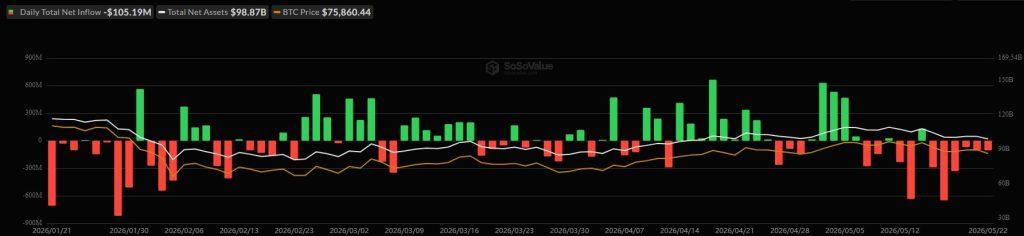
Bitcoin and Ethereum ETF outflows have accelerated, with institutional investors pulling nearly $2.7 billion from spot Bitcoin and Ethereum exchange-traded funds over the past two weeks.
However, rather than signaling a broad exit from digital assets, market data reveal a historic divergence, with these allocators simultaneously rotating into newly launched alternative cryptocurrency funds like Solana, Hyperliquid, and XRP.
The structural shift highlights a maturing market where digital assets are no longer traded as a monolith. That makes the current move a crypto ETF rotation rather than a uniform retreat from regulated digital asset exposure.
Flagship cryptocurrencies like BTC and ETH are facing intense macroeconomic headwinds, while smaller ecosystems are attracting bids based on network-specific fundamentals and regulatory developments.
Bitcoin and Ethereum ETF outflows accelerate
The pace of institutional redemptions from the two largest digital assets has accelerated sharply in recent weeks.
For context, data compiled by SoSoValue show that US spot Bitcoin ETF outflows reached roughly $1.26 billion in cumulative net redemptions last week alone. That represents the heaviest weekly drain since late January.
Combined with the previous week’s figures, spot Bitcoin funds have shed more than $2.26 billion in just 14 days, pushing the category’s total assets under management below the $100 billion threshold.
Ethereum ETF outflows show a similarly sustained exodus. The nine funds tracking the second-largest cryptocurrency posted $471 million in combined outflows across the past two weeks.
This extends their losing streak to 10 consecutive sessions, marking the category’s most sustained period of outflows since March 2025.
The velocity of the retreat in these funds is also clear in their daily trading averages. Timothy Misir, head of research at digital asset firm BRN, noted that the seven-day average of US spot ETF net flows recently fell to -$88 million per day, the sharpest daily outflow pace since mid-February.
However, Misir pointed out a key structural distinction between the two periods. While the February outflows occurred during a period of market weakness, this latest round of redemptions took place as Bitcoin traded near $80,000.
These numbers indicate that institutional managers used the price rebound to reduce their overall crypto exposure rather than add to existing positions.
This distinction alters the interpretation of the current selling pressure. Redemptions during a market downturn typically reflect forced de-risking or defensive liquidations.
In contrast, redemptions into price strength suggest that portfolio managers are capitalizing on available liquidity to rebalance their allocations, particularly when the broader macroeconomic backdrop becomes less favorable.
Macroeconomic triggers behind Bitcoin and Ethereum outflows
Meanwhile, SoSoValue noted that the synchronized selling in Bitcoin and Ethereum is also rooted in a fundamental repricing of macroeconomic expectations, rather than a failure of the underlying technology.
In a May 25 note, the firm noted that the robust rally observed during the spring, which drew $2.9 billion in ETF inflows across March and April, was built entirely on the premise that the Federal Reserve would execute a series of interest rate cuts throughout 2026.
However, that thesis has significantly reversed as recent economic prints show inflation remaining stubbornly high.
Compounding the hawkish economic data is the recent leadership transition at the Federal Reserve.
According to the firm, Kevin Warsh’s confirmation and recent swearing-in as Fed chair have injected fresh uncertainty into the central bank’s policy reaction function.
Consequently, traders are aggressively pricing out easing measures. Futures markets on the CME now reflect roughly a 39% probability of a rate hike at the forward 2026 meetings, while Polymarket pricing suggests a 62% chance of zero rate cuts for the entire calendar year.
Because Bitcoin and ETH are now fully integrated into the traditional financial system, they respond to rate expectations with the same sensitivity as the tech-heavy Nasdaq. When the economic logic supporting a rate-cut environment disappears, the allocation justification vanishes with it.
That repricing explains why Bitcoin and Ethereum ETF outflows have intensified even as capital remains available for narrower, asset-specific crypto strategies.
Alternative crypto fund inflows rise in HYPE, SOL and XRP
Alternative crypto fund inflows totaled roughly $226 million across single-asset products tied to Solana, XRP, and Hyperliquid’s HYPE token.
This divergence represents the primary tension in the digital asset market. Capital allocators are reducing exposure to the largest, most macro-sensitive investment vehicles while remaining willing to deploy money into products backed by distinct, asset-specific narratives.
The split flows reveal a highly selective institutional client base. Bitcoin and Ethereum are increasingly evaluated through a top-down macroeconomic lens due to their size and systemic integration.
Conversely, smaller altcoin products are being judged on bottom-up micro factors, including decentralized application activity, protocol fee generation, specific regulatory status, and cross-border payment utility.
Alvin Kan, chief operating officer at Bitget Wallet, noted that the divergence between large-cap ETF liquidations and alternative fund inflows points to an internal market rotation rather than a structural collapse in digital asset demand.
Kan stated that investors are looking beyond concentrated large-cap exposure to allocate capital toward ecosystems tied to specific operational milestones.
He pointed to Solana’s high-throughput decentralized finance (DeFi) expansion, Hyperliquid’s specialized derivative-trading infrastructure, and XRP’s ongoing integration into cross-border payment networks as clear examples of independent themes attracting institutional interest.
This trend highlights how the expansion of the crypto ETF wrapper is changing portfolio construction.
In prior market cycles, institutional investors seeking regulated, compliant vehicles were restricted almost exclusively to Bitcoin and, later, Ethereum.
The arrival of diversified single-asset products allows managers to express granular investment views without interacting directly with blockchain protocols or managing exchange counterparty risk.
Consequently, the institutional marketplace has become more competitive. While Bitcoin and Ethereum maintain an absolute monopoly over deep liquidity and total assets under management, they no longer monopolize regulated access to the asset class.
Newer products can capture institutional mindshare when their underlying narratives appear less crowded or more aligned with active on-chain growth sectors.
So, if this sector-driven approach persists, the diversification trend could support a much more resilient and sustainable growth cycle for the broader digital asset industry, even as individual assets navigate periods of macroeconomic volatility
The post Bitcoin and Ethereum ETF outflows expose rotation into HYPE, XRP and Solana appeared first on CryptoSlate.